Townhouses are not a traditional housing type in Seattle. We only started building them in significant numbers in the last 15 years, and while their presence is noticeable in the limited areas where they’re allowed, they barely register in terms of overall land use in the city.
But with virtually all available land in Seattle long since developed, there will never be more detached single-family homes than there are today. Townhouses, on the other hand, will continue to be built in our existing lowrise zones. And if proposed changes to the city’s Comprehensive Plan go through, the areas where townhouses are allowed could grow to include some adjacent single-family areas that are near regular transit service.
As the city considers expanding the areas where townhouses can be built, it’s appropriate to ask how the current stock of townhouses have affected housing availability and affordability. With over a decade of townhouse construction behind us, we can start to answer these questions.
The analysis that follows shows that townhouse construction has more than doubled the total stock of family-sized housing in lowrise zones and provided an even more dramatic increase in housing actually available for purchase. Importantly, it has done so while reducing the median sale price, making these neighborhoods accessible to a wider range of incomes. Trends in the last five years, however, show a worrying swing towards more expensive new townhouse construction, which threatens the previous affordability gains.
Note: This article considers “townhouse” to include proper attached townhouses as well as rowhouses and single-family clusters, all of which are classified by the King County Assessor under the same “Townhouse Plat” coding. Apartments and condos are not considered in this analysis.
Background
There are about 13,000 townhouse units in Seattle, the large majority built after 2004. In comparison, there are about 134,000 detached single-family homes, the large majority built prior to 1960. Because townhouse developments average four units per lot, this ten-to-one difference in unit count hides a forty-to-one difference in land area: Seattle devotes about 20,000 acres to detached single-family and less than 500 acres to townhouses. Overall, less than 1% of city land is devoted to townhouses.
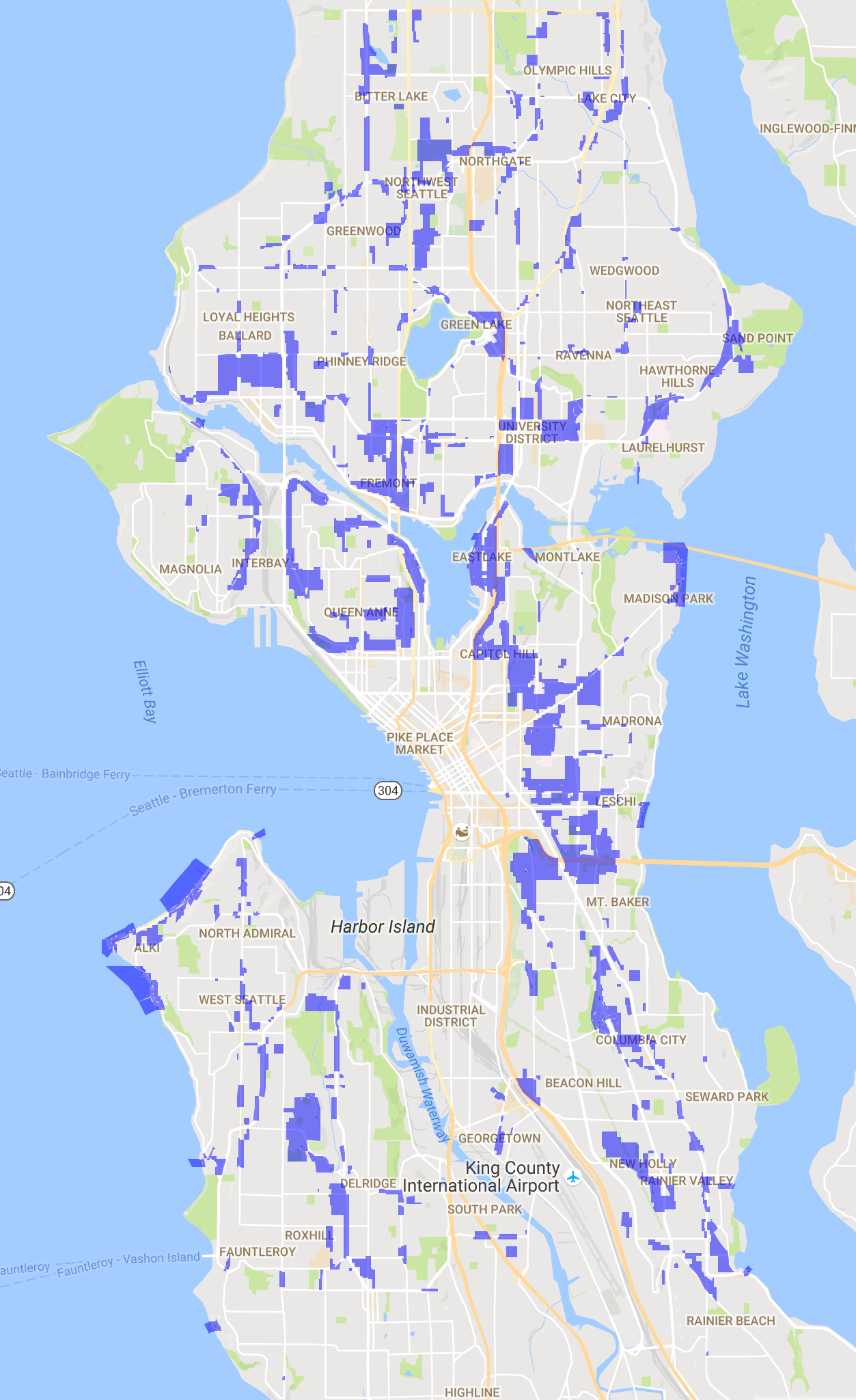
Townhouses are not evenly spread around the city, however. They’re effectively restricted by zoning laws to the 10% of city land designated as lowrise. These lowrise zones sit between midrise commercial districts and the surrounding single-family zones. Within these zones, which can also contain small apartment and condo buildings, townhouses take up almost as much land as detached houses.
Effect on Availability of Housing
While Seattle faces a shortage of housing of all types, housing suitable for families is especially scarce and especially important. We can’t add significantly more detached homes, the traditional ideal of family housing, because there’s virtually no undeveloped land. And without government intervention, apartment and condo construction provides few two bedroom units and essentially no three bedroom units. That leaves townhouses as the only significant new source of family-sized housing.
Within the lowrise zones where they are allowed, townhouses have more than doubled the amount of family-sized housing available, from about 9,000 homes (all detached single-family) to about 20,000 homes (13,000 attached and 7,000 detached). These stats don’t include apartment and condo buildings, which would add only a small amount of family-sized housing.
For people hoping to move into a neighborhood, it’s not the total number of homes in the area that matters, it’s the number of homes that are actually for sale. Here again, townhouses play an outsized role in making neighborhoods accessible to new people. Looking at attached and detached home sales within lowrise zones between January 2015 and May 2016, approximately 2,500 homes were sold. About 700 of those sales were new construction townhouses, 1,300 were older townhouses selling to new owners, and only 500 were detached single-family homes.
In total, 80% of home sales in lowrise zones were townhouse sales. We saw that townhouse construction had doubled the overall family housing capacity in lowrise neighborhoods. But because of new construction and higher turnover, townhouses have tripled or quadrupled the number of opportunities for new households to move into these neighborhoods.
Effect on Affordability of Housing
Providing opportunities for more households to move to desirable neighborhoods is a shallow victory if those opportunities are only available to the rich. Fortunately, with one important qualifier, townhouses are bringing down the median home price in lowrise zones.
Using the same sales data from 2015 and 2016 in lowrise zones, the median prices are as follows: new construction townhouses sold for $625,000, existing townhouses sold for $460,000, and detached single-family homes sold for $560,000. $460,000 for a used townhouse certainly doesn’t qualify as affordable housing in an absolute sense, but compared to the alternative of paying an average of $100,000 more for a detached single-family house, it is still significantly lowering the income needed to move to these neighborhoods.
The new construction townhouses, on the other hand, are pushing up the median price. Grouping existing and new construction together, the median townhouse price is just $525,000, still a moderate savings over a detached single-family home.
Recent Increases in New Construction Prices
It’s not a given that new townhouses have to be expensive compared to older detached single-family homes. In fact, up until 2014, new townhouses were selling for less on average than existing detached single-family homes.
The change to more expensive new construction is worrying. Townhouses are pulling down the overall median price because the townhouses built during the boom of 2005-2009 were relatively inexpensive compared to existing detached homes. With townhouses now being built at a price point above existing detached homes, further townhouse development is pushing up prices.
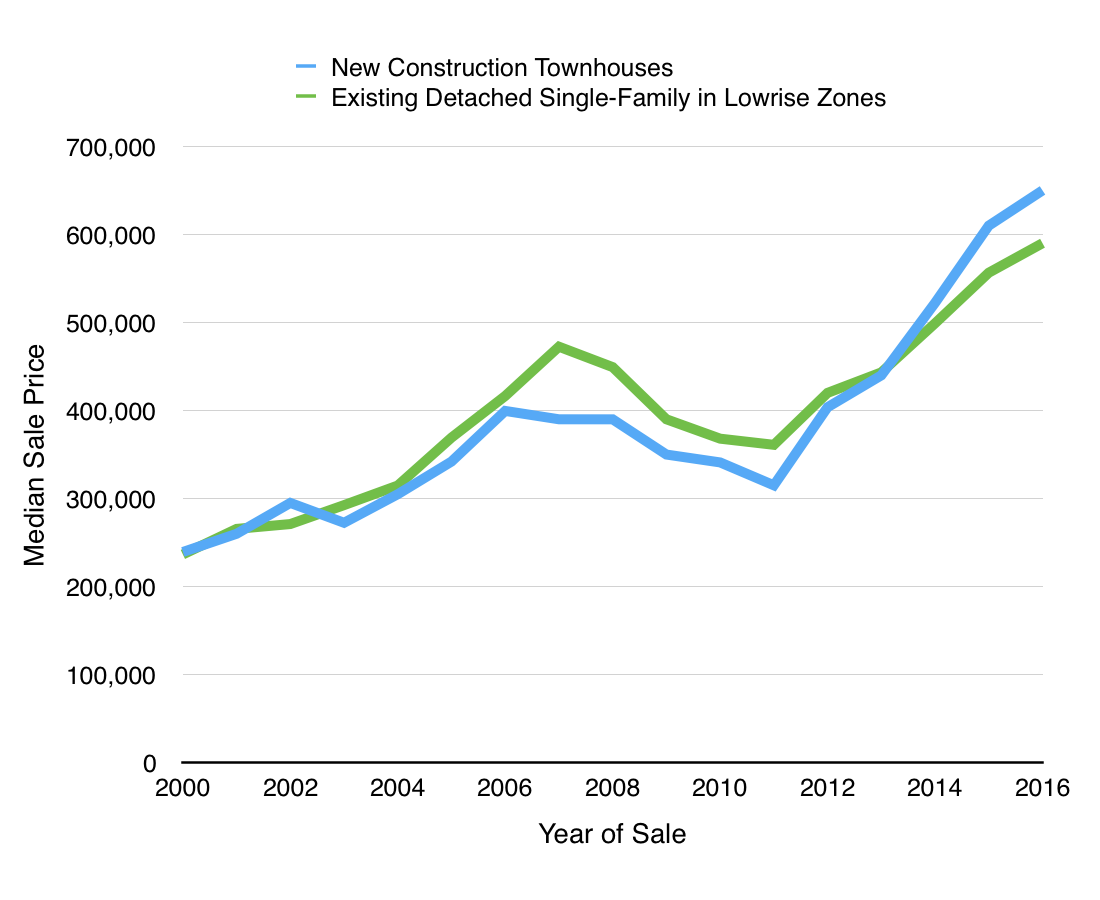
The available data don’t offer much of an explanation for why new construction prices have gone up so much in the last five years. Certainly all prices have gone up, especially in the walkable, transit-rich, mixed use neighborhoods that lowrise zones surround. But that doesn’t explain why new townhouses have gone up in price even compared to existing homes in those same desireable neighborhoods.
A partial answer is that townhouses are getting bigger. From a steady average of 1,360 square feet all through the first decade of the 2000s, townhouses rose to 1,540 square feet on average in 2014. There’s also a slight increase in the cost per square foot for a townhouse compared to a detached house.
But this only leads to the question of why townhouses are getting bigger. Are changes driven by consumers? Perhaps an influx of wealthier people is supporting the building of higher-end townhouses. Or maybe home buyers are warming up to the idea of townhouse living and therefore willing to pay more.
Or perhaps prices are going up because of changing regulations. The lowrise codes have seen numerous revisions in recent years, including, most notably, the 2011 introduction of more stringent design review requirements on townhouses.
As documented by Sightline, since the townhouse design review mandates were enacted, a majority of new projects have been putting a few feet of space between the exterior walls of the units. This means they are technically not townhouses, and thus they avoid the design review requirement (although for this analysis we’ve continued to categorize them as townhouses, since they fill the same market niche). Critically, the extra space between units means builders can’t always fit the same number of units on a lot, which leads to fewer units, each larger and more expensive than they would otherwise be.
These questions call for further research. If recent design review changes are found to be responsible for price increases, then it will be critical for City Council to reconsider how design review requirements can be changed in order to not bias builders towards larger, more expensive units.
Conclusion
The boom in townhouses shows that it is possible to simultaneously add housing stock and bring down prices. Because of townhouses, there are now vastly more opportunities to live in family-sized housing in walkable, transit-rich, high opportunity lowrise neighborhoods. And because townhouses sell for well under the price of detached single-family homes in the same neighborhoods, these opportunities are open to a wider range of incomes.
However, an alarming recent trend towards higher priced new construction puts into question future affordability gains. The causes of this recent increase in price are not yet clear, but may lie in recent regulatory changes that pushed builders towards larger, more expensive units. Determining and correcting whatever has caused prices to rise will be critical for future affordability, especially as the city considers expanding the lowrise zones where townhouses can be built.